
Pelvic Floor Support for Women — Simple, Modern, Effective
Whether you’re navigating postpartum changes, bladder leaks, sexual health concerns, or just want to feel stronger and more confident, we offer practical, non-invasive pelvic floor support that fits real life.
Call us today to have a chat about how we can help.
Why pelvic floor health matters for women
Your pelvic floor is a group of muscles that sit like a sling in your pelvis. One of its roles is to support your bladder, bowel, and reproductive organs. They also play a major role in:
- bladder control
- sexual comfort and sensation
- core stability
- pressure management
- postpartum recovery
- everyday confidence
When these muscles weaken, tighten, or lose coordination, symptoms can appear — often gradually.
Common symptoms women experience
Bladder & urinary symptoms
- leaking with coughing, sneezing, laughing, or exercise
- rushing to the toilet – and sometimes not getting there in time
- when you need to go, you need to go now!
- getting up multiple times at night
- feeling like you “can’t hold on”
- difficulty starting or stopping urine flow
- always thinking about where the next toilet will be
- drips on the seat when standing after emptying your bladder
Postpartum changes
- heaviness or pressure
- reduced pelvic floor strength
- difficulty activating the muscles
- abdominal bulging or doming
- feeling “disconnected” from your core
- leakage randomly or with exertion
Sexual health changes
- discomfort or pain
- reduced sensation
- reduced desire
- difficulty relaxing
- changes after childbirth or hormonal shifts
Core & exercise symptoms
- instability or leakage during lifting/walking/running/jumping
- pressure pushing downward or dragging feeling in lower back/abdomen
- difficulty engaging the core
- back or pelvic discomfort
These symptoms are common, but they’re not something you need to tolerate.
Why these symptoms happen
Pregnancy & childbirth
Both pregnancy AND childbirth can stretch, weaken, or disrupt the pelvic floor muscles and can impact the nerves that help them activate.
Hormonal changes across life
Why muscle loss increases as we age
The key driver is falling estrogen, which affects overall muscle strength.
This hormonal shift affects all skeletal muscle, including the pelvic floor.
And often when it weakens we use it less, which adds to the decline. “If you don’t use it, you lose it.”
Ageing & lifestyle
- high-impact exercise
- chronic stress or tension
- abdominal pressure imbalances
- busy lifestyles that make exercises hard to maintain
Difficulty activating the pelvic floor
Many women try pelvic floor exercises but say:
- “I can’t feel anything.”
- “I forget to do them.”
- “I don’t know if I’m doing them right.”
This is extremely normal — and here’s the physiology behind it:
One reason many women struggle to ‘squeeze’ properly
1. The brain–muscle connection weakens
Pregnancy, birth, pain, trauma, and hormonal changes can disrupt the neuromuscular pathway. The brain struggles to “find” the pelvic floor, making activation feel vague or impossible.
This is a neuromuscular issue, not a motivation issue.
- Pregnancy, birth, pain, trauma, and hormonal changes can indirectly affect the pathways between the brain and the pelvic floor.
- When a muscle is weak, it may influence you to use it less; the less you use a muscle, the ‘fuzzier’ the pathway gets.
- When this pathway becomes “fuzzy,” the brain struggles to find the muscle and send a strong, coordinated contraction instruction.
- This is why many women say: “I’m trying to squeeze, but I don’t feel anything happening.”
2. The muscle itself becomes too weak to respond
If the pelvic floor is very weak, stretched, or fatigued, it may not be able to contract strongly — even with perfect technique.
Even when the brain is doing its best, the pelvic floor may be:
- deconditioned
- atrophied (especially with low estrogen or lack of use)
- fatigued
- stretched or injured from birth
When a muscle is very weak, it can become hard to voluntarily contract, even with perfect technique. It’s the same reason someone with severe quad weakness can’t “just do a squat” — the muscle simply may not be strong enough to perform the full movement.
This is why many women feel like:
- “I’m trying, but nothing is happening.”
- “I don’t feel the squeeze.”
- “I can’t tell if I’m doing it right.”
Use it or lose it — pelvic floor edition
The pelvic floor is skeletal muscle just like your glutes/quads/biceps etc. If it’s not used — or not used correctly — it will weaken over time. Hormonal changes, childbirth, and ageing can accelerate this decline.
This is exactly why modern support exists.
The pelvic floor is skeletal muscle, and behaves like any other muscle group:
- If it is not exercised, strength and muscle mass decline.
- If it is not activated correctly, that brain–muscle connection can weaken, which can lead to further deterioration.
- Hormonal changes (postpartum, perimenopause, menopause) accelerate this decline.
This is why postpartum rehab and lifelong pelvic floor strengthening are essential — and why technologies like Emsella, which activate 90–100% of pelvic floor muscle fibres, can be so impactful for women who struggle to recruit the muscles voluntarily or want to remove the daily mental load of doing your exercises.
How the chair helps
1. It rebuilds strength first
The chair activates 90–100% of pelvic floor muscle fibres, compared to approx. 40–60% during voluntary exercises.
This means:
- The muscle becomes stronger
- The fibres become more responsive
- Both deep and superficial muscle fibres strengthened
- The tissue regains tone and endurance
A strong regularly activated muscle makes it easier for the brain to recruit.
Clients often report:
- “I can finally feel it working now.”
- “I know what it feels like when you say squeeze and lift.”
- “I can feel more than just the surface level muscles contracting.”
- “I can actually feel what I’m doing with the pelvic floor exercises.”
Once the muscle is strong, and the brain can “find” it again, clients can maintain their results with:
- correct pelvic floor exercises
- breath-based coordination
- periodic chair sessions every 3–5 months
Just like any skeletal muscle, if it’s not used, it will weaken again — you don’t go to the gym once and expect to be strong for the rest of your life.
How we help
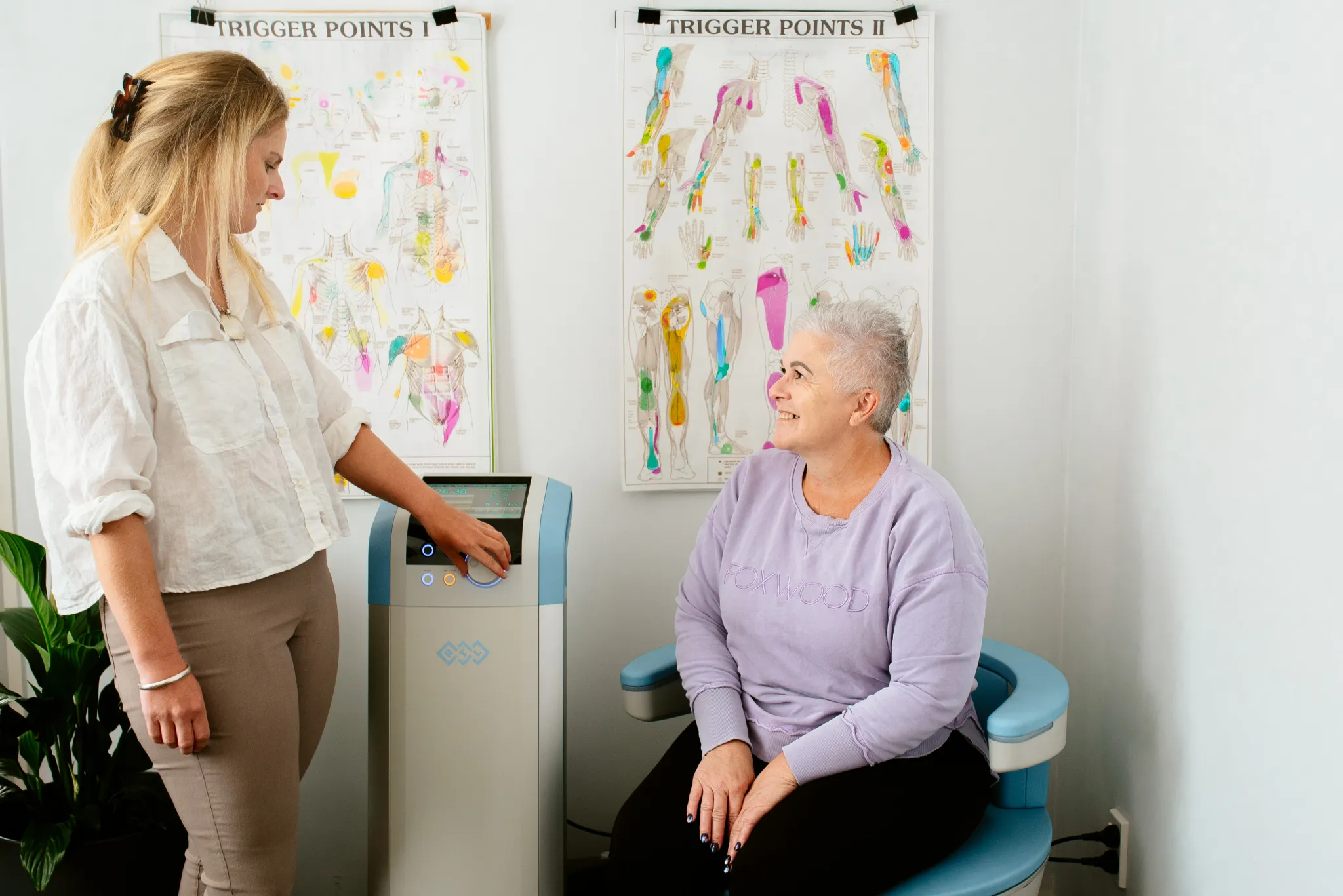
EMSella Pelvic Floor Chair
A fully clothed, non-invasive treatment that delivers thousands of accurate pelvic floor contractions in one session.
Ideal for women who:
- leak with coughing, sneezing, exercise or randomly
- have urgency or frequency
- get up multiple times at night
- feel weak or disconnected postpartum
- want support for sexual comfort, satisfaction and confidence
- struggle to activate their pelvic floor
- want a simple, time-efficient option
What it feels like: a gentle tapping or lifting sensation — never painful.
Why EMSella works so well
1. It strengthens the muscle correctly
EMSella activates 90–100% of pelvic floor muscle fibres, compared to approximately 40–60% during voluntary exercises.
This means:
- the muscle becomes stronger
- the tissue regains tone and endurance
Postpartum pelvic floor support
We help women understand:
- pressure management
- core–pelvic floor coordination
- how childbirth and pregnancy affect muscle activation
- why exercises may not feel effective
- how EMSella supports recovery
Sexual health support
We provide education around:
- pelvic floor tension vs weakness
- how muscle function affects arousal and comfort
- how strengthening improves blood flow and sensation
- how EMSella supports sexual health
Bladder control & confidence
We help women understand:
- stress vs urge incontinence
- why leaks happen
- how pelvic floor strength improves control
- how EMSella supports bladder stability
What to expect at your appointment
- 1
Conversation & health history
A relaxed, private chat about your symptoms, goals and overall health history.
- 2
Education
Clear explanations about what’s happening and why.
- 3
Personalised plan
We discuss a specific plan tailored to you, taking into account your health history and goals for treatment.
- 4
Treatment
You sit fully clothed on the chair for a 28-minute session.
- 5
Support
We guide you through your progress with extra information to optimise results, help you understand what to expect, and are always here to help.
Why women choose us
- private, comfortable environment
- modern, non-invasive technology
- clear explanations without embarrassment
- support for postpartum, sexual health, and bladder control
- simple solutions that fit busy lives
- no internal exams
- no need to remember daily exercises
Ready to feel stronger, more confident, and more in control?
Book a consultation or ask us anything — we’re here to help.